
As blog owner, and lover of truth, I am pleased with the volume of discussion generated by one of the recent posts. Considering that: further discussion about the Highest Thing (quite obviously the highest in this case) is eminently worthwhile; the subject matter is, as Mathetes points out, extremely subtle; the interpretations of St. Thomas' argument among our group seem to be wildly different; the scope of the topic is quite large for blog-sized posts, with many sub-topics being covered in each comment; and finally, precision and order are most helpful to intellectual progress; I have decided to expand the post into a series, each installment offering a forum for discussing a particular aspect of the argument.
This first post will lay out the topics to be covered by subsequent posts.
The goal of our discussion is to come to an understanding of St. Thomas' Fourth Way, both in the sense of St. Thomas' intention and of its truth. Although it's been posted already in bits and pieces, here is the argument for the sake of reference:
Based on our initial discussion, it seems important to be able to account for the following:
I'm assuming Mathetes' question about other texts will be answered in conjunction with the above points. I realize that some discussion is very difficult without addressing the argument as a whole, but hopefully this method will give us greater clarity by limiting the comment threads to one train of thought at a time. Let's leave the original post for discussion solely about Mathetes' proposed argument. Any methodological comments (suggestions for additional questions to consider, etc.) should go here, and, if there are no objections, I'll begin posting on the specific topics right away (meaning tomorrow night, since it's late). Disputemus!
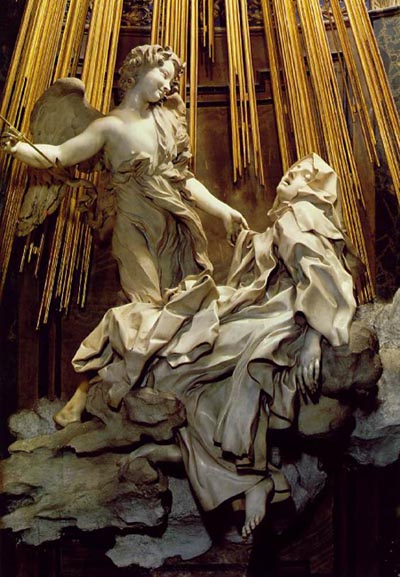
Monday, 15 October 2007, On the Memorial of her Transverberation of Heart
b. 1515 d. 1582
Teresa of Avila was born a Spanish noble, the daughter of Don Alonso Sanchez de Cepeda and Doña Beatriz. She grew up reading the lives of the saints, and playing at "hermit" in the garden. Crippled by disease in her youth, which led to her being well educated at home, she was cured after prayer to Saint Joseph, to whom she kept a great devotion to throughout her like. Her mother died when Teresa was 12, and she prayed to Our Lady to be her replacement. She was famed for her beauty; this was both a cause for youthful licentiousness and later conversion and conviction to enter religious life. Her father opposed her entry to religious life, so she left home without telling anyone, and entered a Carmelite house at 17. Seeing her conviction to her call, her father and family consented. Soon after taking her vows, Teresa became gravely ill, and her condition was aggravated by the inadequate medical help she received; she never fully recovered her health. She began receiving visions, and was examined by Dominicans and Jesuits, including Saint Francis Borgia, who pronounced the visions to be holy and true. She considered her original house too lax in its rule, so she founded a reformed convent of Saint John of Avila. She founded several houses, often against fierce opposition from local authorities, and yet stated "May God protect me from gloomy saints," and governed her convents thus. Later, having made the acquaintance of Antonio de Heredia, prior of Medina, and St. John of the Cross (who became her spiritual director), she established her reform among the friars. She is a renowned mystical writer, celebrated for her Autobiography, her Interior Castle, and her Way of Perfection. She died 4 October 1582 at Alba de Tormes in the arms of her secretary and close friend Blessed Anne of Saint Bartholomew. Her body is incorrupt with the relics preserved at Alba; her heart shows signs of Transverberation (piercing of the heart), and is displayed, too. She was beatified in 1614 and canonized in 1622 by Gregory XV. She wasproclaimed a Doctor of the Church on 27 September 1970 by Pope Paul VI. The requisite elements required to be endowed with the title 'Doctores Ecclesiae' are enumerated as three: eminens doctrina, insignis vitae sanctitas, Ecclesiae declaration. God gave us faculties for our use; each of them will receive its proper reward. Then do not let us try to charm them to sleep, but permit them to do their work until divinely called to something higher.
She is, therefore, a great friend and guide to the life of faith and reason.
-St. Theresa of Avila
Hello Friends,
Heard of this interesting new group this morning. Seems like there is much to like about them. I am curious about your opinions of it.
I found their 'third principle' regarding The Commentator as strange- we are aware of Cajetan's misunderstandings about analogy. Moreover, the church certainly has not spoken of him as having authority likened to Thomas, and so I wonder if "energetically" defending "the philosophic doctrines of the Scholastic Expositor in his explanations of them, even if he does not fully grasp their meaning or import," as they say, is really a fitting docility.
Also in the 'fourth principle' DeKonnick was excluded from the list of 'faithful' and 'continuous line of Thomist,' though they admit that the list is not limited to what they include.
Lastly, I wonder at the significance in excluding the mention of Aristotle as "The Philosopher."
DISCUSS.
Best wishes.
Aquinas in the Quarta Via argues that there must be something that is most true, best, etc. and most of all being. The reason for this is due to the fact that "magis et minus dicuntur de diversis secundum quod appropinquant diversimode ad aliquid quod maxime est, sicut magis calidum est, quod magis appropinquat maxime calido. "
Why is it that more and less must be said with reference this sort of necessarily existing maximum?
It seems to me that it is inadequate to say it is in the very meaning of relatives that there be an external exemplar, due to the fact that a further argument is needed to manifest that the proposed exemplar measure is more than something arbitrarily posited.
I am not clear about how such an argument would be conducted to answer my question generally. However, it is unwise to ignore the examples given in the argument: good, true, noble, "et sic de aliis huiusmodi." So I would like to propose an argument I recently encountered that I think satisfactorily answers my question in the case of the good. It is still fresh in my mind and I apologize for the lack of formality in my formulation....
Here it is:
-It is the nature of the good not to be limited in its essence.
-Those things which have the good in a limited way therefore do not possess goodness by their essence.
-If it is not from a thing's nature to possess the good, i.e. its essence is not the cause of its goodness, then there must be some other cause whereby it possesses the good.
-This cause either must possess the good in a greater, but similar manner as said things, and is subject to the same explanation, or it must possess the good in an essential way.
-The former case may not go on infinitely.
-That which possesses the good in an essential way therefore possesses the good in an unlimited way.
-And surely to possess any thing in an unlimited way is the maximum or most way it can be possessed.
Therefore, etc. (Corollary: it also seems you could argue similarly with the other examples)
My next question is: What exactly is the common ratio of the aliis huiusmodi? Are they all transcendentals?
Secondly, where in Aristotle and Aquinas is there a greater explanation of these things (I think I should have asked this long ago...)?
Thirdly, is there an answer to my general question posed above?
A difficulty concering the role of the efficient cause in nature
9 comments Posted by ho mathetes at 1:21 AMA recent difficulty was posed in an article entitled "Aquinas and Newton on the Causality of Nature and of God: The Medieval and Modern Problematic" by William Wallace, which I was assigned for a Natural Theology class I am taking. The article states a difficulty about the role of the efficient cause in nature I was hoping to get some help resolving.
He argues, in conformity to Physics II.2, that nature in Aristotle is obviously argued to be a cause formally and materially, and later also argued to be a final cause insofar as it is a telos in II.8. However he contest, despite the obvious numbering of efficient cause by Aristotle in II.3, that Aristotle does not argue that "nature acts as an efficient cause." There is an obvious exception, shown in the De Anima, where the soul is a sort of self-moving efficient cause. But he contest that there is no account of natural efficient causality amongst the non-living. There seems to be some ground for this position, he holds, for the principle "Omnes quod movetur ab alio movetur" seems to assume it, and Aristotle clearly takes up this principle later in Physics VII.
The other qualification is that natural things obviously, self-evidently in fact, are the efficient cause with respect to moving other things, c.f. I-I q.2 art 3. So the question lies more in the role efficient causality plays as an intrinsic cause of some natural being, say, for the sake of contention, a falling ball.
DISCUSS.
Dull sublunary lovers’ love
A deuely dele in my heart denned
He dein’d cam with wind wavis stille
With heart whose love twas innocent
Shone forth bout wan wood mine
Stille resteth sae, O empeyreal skye
Nae tremblith (effraide –alarmed)my
Late weary waited I through wayward thought
Stir hartiness for my heart and yet I the hind
O Orpheus bid that forest move!
The forward footing tward an hidden shade
Vertue gives her selfe light, through darkenesse for to wade
My self prepayre for he is coming strayt
With naked foot he softly step
to I in chamber made wait
He doth dripth aryse fayre love
Lyllies born rusl’ed feth turtledoeve
Song Thousand shield coateh waitih grove
Strong An gartheth lions pomegrans
Mandrakes long give foth fragrance
And thus did they depart
NOTES
Line 1: From
Line 2: From “
Line 3: C.f. "I Sing of a Maiden”
Line 6: Evening star
Line 7: Wan =dark
Line 12: Note puns on hartiness; hart = male dear, and hind = female deer
Line 13: close/awayt = secret/ambush
Line 13: hew = form
Line 14:
Line 17: Direct quote from
The following is a re-articulation of an online dialectic I gave for the existence of concepts as part of the experience of 'thought.' It was given to an unusual audience of self-described material atheists and agnostics within a very casual forum. It is “just an introduction to my ideas of mind and concepts” to such an audience and I was not interested in pointing out the scientific (or unscientific) nature of the arguments given (in the sense of episteme in Posterior Analytics Bk. 1, 2). More specifically, I try merely to manifest, describe, and explain basic properties of a part of the conscious experience- touching on science but as a philosopher. Given the audience, the arguments are correspondingly somewhat atypical in form and matter for its subject, at least for those from the same school of thought, namely Thomism, as I the author. I am posting it with the hope that such like minds may provide their estimation of the essay’s veracity.
To begin, I will take the term ‘thought’ vaguely here, and am not in any way excluding it to humans or even primates (that issue is outside of my prerogative). Also, I want to leave behind certain arcane and stinging-sounding terms that for my purposes would be more of a distraction than an aid. I am here deliberately absconding from describing the phenomenon at hand as being 'of the soul.' 'Soul' for the Greeks really didn't commonly mean more that 'principle of living (or principle of any certain operation of life, such as thought) and it just doesn't mean the same nowadays, now it is something far more specific and kooky. I think there is a need to recognize the phenomenon of thought vaguely. So take thought here as merely the discursive process where the conscious 'mind' beholds something outside itself (or itself as outside itself). Let's begin with an example.
Think about a cat. Obviously you have some image of a cat. Was it fat or skinny? Say it was skinny. Does that mean a fat cat is not a cat? It would seem that you would still call a fat cat a cat. In fact, if I told you to think of, oh, five cats, one of them probably would have been fatter or skinnier that the other. Suppose, after a bit of reflection, we may see, at least for the sake of argument, that our thoughts about cats include a certain limit to their dimension. At this point we leave the cats behind. Consider that the range of size itself conceptualized does not have a greater dimension. A two foot thing is bigger than a one foot thing. But is a notion of 'two' a bigger one than 'one?' There would seem to be something nonsensical (pardon the double entendre) to about notions being a strictly measurable thing in the first place, and one notion would not measure the other as a notion with respect to size. These so called 'notions' or 'concepts' are the part of thought I am interested in.
This dialectic is certainly inconclusive but I think it also points to something described in another ubiquitously pragmatic neurological pretext as the "storage" problem. A 'concept,' just considering the meaning of the word, is a perplexing thing. They're abstract: 'two-ness' itself isn't simply found as 'two-ness' in any thing's definition. Further, they're common. Taking their meaning alone, their common or universal: "Two-ness" explains any case of 'two,' i.e. you can find them in any appropriately applicable case. How does would an abstract, common thing come from something that is has quite concrete operations, and is particular?
Some, as far as I can tell, mainstream neurobiologist seems to be open to the idea of concepts being at least a very unusual case (according to my neophyte understanding). It is true, that many particular cases of brain operations such as the neural processes behind discernment, reportability, perception, etc are rapidly being explained by neuroscience. But one example of the neurobiology papers I have encountered that notices the peculiarity of concepts (Semantic Memory and the Brain: Structure and Process, by Alex Martin and Linda Chao, found in Current Opinion in Neurobiology 11, 2001) states the problem this way:
If you think about this, if it is true, it is strange. The claim is that loci in the brain for categorical thought are limited by the fact that the brain itself is limited by what it is. Even more paradoxically, it seems we are able to know a potential infinity of categories of concepts, each category containing therein an infinite number of its own exemplars. Take as an example that there is no limit to how many geometrical figures one could learn, and one can easily imagine an infinity number of any one of those figures, as a case take a circle and continuously extend it's radius). In other words, there is no saying "my brain is full" like the Far Side cartoon. I think it is a sufficient to show that, but not why, there is really is such an infinite is a possibility of mind just by considering such aforementioned geometrical cases, or a case of infinite conjunction (there is something algorithmic about it, actually). See Noam Chomsky's comments on this "creativity" in Aspects of the Theory of Syntax, Ch. 1.
Another difficulty with concepts is from the property of simplicity that is found in certain concepts. Consider the first and most fundamental act of the mind, sometimes referred to as the simplex apprehensio. In this act the mind first apprehends merely that something is. Contextual examples or illustration is the only means of describing this concept. That is, seeing something as a "this" prior to any sort of defining. Suppose that a neuroscientist claimed to explain a concept 'black dog' via showing how the parts of the meaning were spatially distributed and correlated in different sectors of the brain; i.e. black is at location A, dog is at location B, and the relation (be it some mediation or overlapping cortical regions) between the two give rise to the concept of 'black dog.' Would the concept of unity understood in the unity of the words also be "overlapping?" I think with this explanation you run into a similar situation that Plato was criticized for in Aristotle's 'third man argument,' where an explanation leads the fact that another 'overlap' would be needed to distinguish how the 'black dog' and 'unity' are both 'one', et cetera ad infinitum. Scientifically speaking, how conceptualization may differ in kind from imagining, memory, or other related processes which, to my knowledge, has been shown to have a direct correlation to brain activity might be elaborated on by the argument above. I admit again, however, that my neurobiological knowledge is nothing really more than what I have studied on my own, and I imagine this isn't at all responding to other opposite positions regarding the status of mind in neurobiology.
Of course the greater historical dispute of how concepts seem to differ from other significant mental beings or processes, such as those often related to imagination, has long (even all the way back to the pre-Socratics) taken place is in the philosophical sciences. Hume, as you well know, was the main advocate of conflating concepts and images and making them the same thing fundamentally. I'd like here to provide a brief response to his position. First of all, it seems to me easy to see that, at least at first appearance, there is a difference in speech of 'a cat' and 'what it is to be a cat (whatever that may be)'. The difference is this: that in the first case there is only one example you can give, and in the second there is an indefinite. This can be seen even easier if you consider 'some two,' say two feet, and 'two' as something that is said of many. I am deliberate in using 'said' here because the case seems indisputable as a linguistic phenomenon. We simply speak this way. Moreover, what is understood when a word that can be said of many things is that (at least with the basic definition of the word being applied) it retains its meaning in any case it could be applied to.
Hume's reply is that this 'universalizing' is merely a linguistic convenience, useful for commerce and conversation, but what really is happening in the mind is merely a compiling of particular cases; lining them up, if you will. To me this somewhat misses the point (not to deny it has been developed to a more powerful position by analytic philosophy). To quote his Enquiry, Section 12, 1:
Actually, if there is to be any science at all that is not tautological generalization must happen. Algebra is a great example of how science per se in some way general. However, I think the better response is in the simple fact that thought doesn't ordinarily differ from speech. Our thoughts are in fact the source of meaning in the words we use, and we speak abstractly. Really, whose interior monologue is really different that how they speak?
The analytic philosophers here raise the more fundamental objection to abstract thought. They are permissive of my reply, but then ask coyly, 'but what makes the thoughts anything more than words?' The more despondent of the analytics (including, I think, the late Wittgenstein) end up thinking there is nothing more than words and their proported 'meanings,' which are also just words - amounting to scepticism.
There are a few different ways to counter to this argument. One way that I will not attempt here would be to appeal to the first principles of knowledge; such as the fact there is a self-contradicting incoherence in their claim (or non-claim, for that matter) that is meaningful that concepts are mere convention. This works for me, but the fleshed out argument is very involved, has gotten massive attention by most of the history of philosophy's 'big guns' whom I would be obliged to consider, and may come up anyway if and when we ever discuss Kant. Rather, I'd like to give an argument derived from a discussion Kripke has considering a problem first posed by Wittgenstein.
Suppose your math teacher asks you do a computation you have never done, say 68+57. Suppose further in adding you have never arrived at a solution over 57. You add and get 125, mathematically and metalinguistically correct; metalinguistically meaning just the '+' was the same function you intended the same meaning you always have when you add. But the skeptic classmate to your conclusion and insist that if you really had intended the same function you would have said 68+57= 5. Obviously this doesn't seem right. But the skeptic argues that you couldn't have given yourself perfectly explicit instructions that 125 is the answer here, by hypothesis. What you are doing is applying the rule you have used when adding in the past, and hence you have only instantiated the rule a finite number of times. Further, he continues, in previous operations, the function you were denoting by a '+' was actually a '£,' which will derive the sum x and y if x and y are >57, but will solve with a '5' if otherwise. So, he would conclude, you were not actually using '+,' you were using '£.' To clarify, the skeptic is not asking "How do you know that 68+57= 125?" Rather the question is "How do you know that in '68+57' the '+' used in the past will denote 125? Perhaps before, he will claim, you meant '£,' and so 68+57= 5. You know this is wrong and scour the past usages of '+,' all with sums less than 57. But you find that the facts of your past usages are compatible with either sign. This is when a different matter of fact occurs to you. You are able to articulate the rule of addition, without having to utilize in that definition any particular case. But in order for you to claim this, the fact must be apart from the particular instances you have done. This is not to deny you may have arrived at the fact in someway via dealing with cases of adding. But it also is to say that at some point you saw something behind the cases you had to deal with. The solution hence lies in the fact that we understand what we mean-- despite the fact that material cases of our thought do not disambiguate them from meanings distinct from, but close to, the thoughts intended. I think this is a big deal. The same physical structures instantiate different functions (Tangentially, super computer processes, have brought this more to light, with chess and other examples) but only via the usage of concepts does one disambiguate.
So if I were to summarize my points so far I suppose I would say that the phenomenon of concepts has unusual and distinctive qualities that require explanation. I think a lot of time could be spent disputing and defending even what I have said. Some of the conclusions that would follow from the properties of concepts I have elucidated are also quite contentious, as you probably can infer. It strikes me something like getting groceries at the market; you don't need to be in the market while having them just because you needed the market to get them in the first place. Perhaps such an explanation is needed for concepts too. I wish I knew science better. But now I'm rambling.
When considering the dignity of man, or specifically, the dignity of the human person, it is important to understand that such a notion is not a first principle and that this dignity must arise from what it is to be a human person. If this is not done, then the phrase loses all meaning and relevancy, and becomes like an anchorless boat in the harbor, carried on the tide of human emotion and opinion now drifting towards the rocks of error, now towards the open ocean of meaninglessness. Rather, it is important to anchor this concept to a true principle and thereby give it both meaning and relevancy. I propose as that necessary first principle, the definition of a person as manifested by, first Boethius1 and then St. Thomas Aquinas2, namely, “an individual substance of a rational nature.”3 Taking this as my true principle I then propose that the source of the dignity of the human person arises not from our being an individual substance, but from our rational nature. The very word, dignity, is itself somewhat ambiguous as to its meaning, and it must first be tied down in order to guide this consideration. In light of the thesis of this paper I do not mean to find some very determinate account of dignity, but rather something general that will fit its uses today. The word is derived from the Latin dignitatis, which is translated as worthiness. This is not far beyond what the word means today for it seems that when we speak of the dignity of some one or some thing, we intend to say that it is worthy of some respect and/or honor because of its character or quality. For example, we rebuke a man for having lost his dignity on account of doing something shameful, such as flinging himself at some woman after she has already poorly used him several times before. We say this because we see that he is not acting in a way worthy of a man, but is being compelled by some weakness within himself. The definition of dignity, then, as worthiness of some respect and/or honor, seems to be sufficient. It is therefore true that dignity must arise from what is most noble in a thing, for we do not respect or honor something because of what is base in it, but because we see what is most excellent in it. For example, we do not give honor to war hero because he has appetites, but rather because he has shown an excellence in virtue, specifically in courage. The dignity of a human person therefore, must arise from what is most noble in the human person. That a man's rational nature is the most dignified part of his person is clear from the following argument: First, as manifested by Aristotle in De Anima, the rational nature of man arises from his intellect, which is immaterial. What is immaterial is more excellent than what is material because it is not parted, it therefore has no principle of corruption, and is therefore incorruptible. The intellect, therefore, is the most noble part of a man. But his intellect is that by which man is said to have a rational nature. His rational nature is therefore most worthy of respect and honor, and is therefore the source of his dignity. That man's dignity does not arise from his individuality is clear first of all by considering that if this were true in man, then it seems that there is no reason it would not be true universally. Therefore, any individual substance would have dignity. Therefore a man and a stone would both have dignity, based on individuality, but this is manifestly absurd, for no one speaks of the dignity of a stone. Even if it is objected that the individuality of man might more properly arise from a higher principle, such as God willing and loving the individual, this does not suffice as an account for man's dignity. For, according to natural reason we can understand God's willing and loving the individual in so far as God is the agent cause of being.4 Here again we see that there is no essential difference, with reference to being alone, between the man and the stone. If then, we bring in the idea that man is more of an individual than the stone on account of his rational nature, then it must be asked why would one take rationality together with individuality, if rationality is sufficient. Further, if one holds that God loving and willing the individual man is not as agent cause of being, but rather as redeemer of this individual, then he departs from the realm of philosophy. For, man does not relate to God as redeemer according to the order of nature, but according to the order of grace and inasmuch as he is a child of God. This, then, misses the purpose of the inquiry and fails to give an account of man's dignity from his nature.5 Finally, it seems that the most common argument for the dignity of the human person arising from his individuality is as follows: each human person is one of a kind and therefore rare. Things that are rare are valuable, and have worth. Therefore, each person, on account of his individuality and rarity has dignity. This argument, however, fails to consider that just because something is rare does not mean that it is good. There was only one Hitler, and it seems to be good that there is only one and we would not consider it a loss to not have more. Rather, if something rare is to be valuable, it must also have something good and excellent that arises from its nature that makes that thing desirable. This is not to deny that rarity is a principle of value, but it must presume that the rare thing is good. It is therefore clear that man's dignity arises from his rational nature and that individuality in no way causes his dignity.
1. De Persona et Duabus Naturis Contra Eutychen et Nestorium , 4
2. I, Q.29, a.1,2
3. It is not my intent to defend this principle here, but rather take it as my starting point. The two great minds above have sufficiently shown this definition to be true.
4. For, insofar as God wills something he brings it into act. To will any other being is to cause its being and since being and good are the same in re, it follows that being as being is lovable.
5. This is not to say that an argument from theological principles cannot be made. Only, it is not my purpose here to make such an argument.
The Church has long celebrated the Holy Innocents as martrys slain for the sake of Christ. The Collect of the Missa "Ex Ore Infantium" on their Feast Day is sufficient to show the Church's position in this regard:
But how can infants, who are too young to use their wills, be considered martyrs? For not everyone who dies violently is considered a martyr. Even if someone were to die at the hands of an enemy of Christ, it seems they would not be martyrs unless they WILLINGLY suffered death. For example, imagine a citizen of a predominantly Catholic country who is killed by terrorists. The terrorists may have killed him out of hatred for Christ and His Church, but they could be mistaken in their assumption that killing the man was an attack on the Church. The man could be a non-Christian or even an anti-Christian. Our imaginary victim would have died because of the Faith, but he would not be celebrated as a martyr because he did not suffer death willingly for the sake of Christ. Similarly, granting that the Holy Innocents suffered death because Herod hated Christ, they did not suffer their deaths willingly since they were not old enough to exercise reason. How, then, can they be martyrs?O God, whose praise the martyred Innocents on this day confessed, not by speaking, but by dying: destroy in us all the evils of sin, that our life also may proclaim in deeds Thy faith which our tongues profess. Through our Lord Jesus Christ, Thy Son, who liveth and reigneth with Thee in the unity of the Holy Ghost . . .
The kind of thinking that gives rise to this objection is, at the root, Pelagian (or semi-Pelagian at best). Most martyrs do willingly suffer death, but this act of the will is not a natural movement - it proceeds from charity infused by God. If the martyrs' act of will is a gift of God, cannot God also give the reward of the act of will, namely the crown of martyrdom, to whomever He pleases?
Why, then, should we celebrate the Holy Innocents as martyrs but not our hypothetical anti-Christian slain for the Faith? Cannot God also give that man the grace of martyrdom? Surely God can, but it seems that God did not if the man had an IMPEDIMENT in his will against dying for such a cause. We can assume an anti-Christian would consciously resist dying for the sake of the Faith if he were sufficiently warned of imminent danger; the infants would have no such willful resistance.1 We should distinguish, then, between "unwilling," such as is the anti-Christian who chooses against dying for Christ, and "non-willing," such as are the babes who do not choose one way or the other.2
The case is similar with Baptism. A baby can receive the grace of Baptism without willing it. A grown man, however, must desire Baptism; for, if he does not desire it, since he has use of his will and is presented with the choice, he desires NOT to have it. Whether it be the salvific grace conferred at Baptism, or the glorious palm of martyrdom, he who denies that a baby can receive it denies the graciousness of God's gift. Hence Augustine says, addressing the Holy Innocents:
____________________A man that does not believe that children are benefited by the baptism of Christ will doubt of your being crowned in suffering for Christ. You were not old enough to believe in Christ's future sufferings, but you had a body wherein you could endure suffering of Christ Who was to suffer.3
1. We can say that the anti-Christian has an impediment in his will even if he isn't reflecting on the decision at the time of his death, e.g. if he is attacked by surprise. For he has willfully formed an habitual inclination to choose against dying for Christ.
2. c.f. a similar distinction made by Aristotle, Nicomachean Ethics, Bk. III
3. De Diversis lxvi, as quoted by St. Thomas in II-II Q.124 a.1.
For anyone interested in philosophy of science, here's a paper on how to classify Galileo's science of local motion according to the principles of St. Thomas laid out in his commentary on Boethius' De Trinitate.
Discovering why St. Luke spends so much time describing the Nativity, when according to St. Thomas his main purpose is extolling the priesthood of Christ, involves looking at the details of the Evangelist's account:
The Church Fathers1 have given me at least plausible answers to my question: it's time to move on with the commentary.
...to cite a few authorities. It is fitting that St. Luke should include this detail , as it is pre-eminently the role of Christ the High Priest to offer redemption to the world and salvation to the elect.
Christ's birth in the House of Bread can be taken as a foreshadowing of the Blessed Sacrament, or as a figure of the redemptive nourishment Christ provides to his elect. Either way, this detail is intimately connected with his priesthood.
Once again, Luke's description of our Lord's birth is ordered toward demonstrating his role as High Priest and Redeemer.
____________________
1. via the Catena Aurea
The account of the Magi in the Gospel according to Matthew is given as a manifestation of the Incarnation, not only as a figure of the universal redemption of Christ the High Priest.1
In fact, of the senses of Scripture, the interpretation of the Magi as manifestation of the Incarnation seems to be the more literal one. Therefore, since the literal sense is the foundation of all other senses and is the primary intention of the human author, it makes sense for St. Matthew, focusing on the Incarnation, to discuss the Magi at length.
But why does St. Luke, primarily interested in Christ as Priest, detail the Nativity? To be continued...
____________________
1. At least, according to St. Thomas' interpretation.
Another comparison of the Gospels according to Matthew and Luke makes one question St. Thomas' distinction between the two. For, as has been said, St. Thomas claims that, "Matthew takes up describing the carnal generation of Christ...Luke, however, chiefly intends to commend in Christ the priestly character."1 Why, then, does St. Luke present a more detailed exposition of the Nativity of Christ, while St. Matthew emphasizes more the Adoration of the Magi? It would seem that the Evangelist wanting to describe the Incarnation would spend more time talking about the Nativity, and the one focusing on Christ the High Priest - who reconciled the world to God2 - would highlight the gentile kings coming from afar to worship the Infant King.
To be continued...
(meaning: I don't have an answer yet)
____________________
1. Super Evangelium Matthaei, Ch. 1, lect.2
2. ST, III, Q.22, a.1, c.

The Institution of the Eucharist - Joos van Wassenhove (active c.1460-80)
Sequence for the Octave of Corpus Christi
| Lauda Sion Salvatorem; lauda ducem et pastorem in hymnis et canticis Quantum potes, tantum aude quia major omni laude, nec laudare sufficis. Laudis thema specialis Panis vivus et vitalis, hodie proponitur. Quem in sacrae mensa cenae turbae fratrum duodenae, datum non ambigitur. Sit laus plena, sit sonora, sit jucunda, sit decora, mentis jubilatio Dies enim solemnis agitur, in qua mensae prima recolitur hujus institutio. In hac mensa novi Regis, novum Pascha, novae legis, phase vetus terminat. Vetustatem novitas umbram fugat veritas, noctem lux eliminat. Quod in cena Christus gessit, faciendum hoc expressit in sui memoriam. Docti sacris institutis, panem vinum in salutis, consecramus hostiam. Dogma datur Christianis, quod in carnem transit panis et vinum in sanguinem. Quod non capis, quod non vides animosa firmat fides, praeter rerum ordinem. Sub diversis speciebus signis tantum et non rebus latent res eximiae Caro cibus, sanguis potus manet tamen Christus totus Sub utraque specie. Asumente non concisus, non confractus, non divisus: integer accipitur Sumit unus, sumunt mile: quantum isti, tantum ille: nec sumptus consumitur Sumunt boni, sumunt mali: sorte tamen inequali, vitae vel interitus. Mors est malis, vita bonis: vide panis sumptionis quam sit dispar exitus. Fracto demum sacramento, ne vaciles, sed memento, tantum esse sub fragmento, quantum toto tegitur. Nulla rei fit scissura: signi tantum fit fractura, qua nec status, nec statura signati minuitur. Ecce panis Angelorum, factus cibus viatorum: vere panis filiorum, non mittendum canibus. In figuris praesignatur cum Isaac immolatur: Agnus Paschae deputatur: datur manna patribus. Bone pastor, panis vere, Jesu, nostri miserere: Tu nos pasce, nos tuere: tu nos bona fac videre in terra viventium. Tu qui cuncta scis et vales: qui nos pascis hic mortales: tuos ibi commensales, coheredes et sodales, fac sanctorum civium. Amen. Alleluia. | Praise thou, Sion, praise thy Saviour! Praise thy Prince with all thy fervour! Anthems to thy Shepherd sing. All thou canst, do thou endeavour, Yet thy praise can equal never Such as merits thy great King. Duty this today thou'rt owing, Bread the living, life-bestowing, Full to honour with Thy praise. Same the bread that Christ in leaving To the twelve, each one receiving, Gave, no one doubt can raise. Let thy praise be loud and swelling, Be it joyous, loud and welling From a full, exulting heart. Mem'ry of that feast we render, Keeping rites in solemn splendour, When Christ did first Himself impart. This new Feast, the old repeating, Newer King and Pasch revealing, Usher in a newer rite. What is new to age succeedeth: Place to Truth the shadow cedeth; Radiance puts the gloom to flight. What He did, that eve reclining, Done anew He willed, assigning This a token of His love By His sacred precepts guided, Make we bread and wine provided, A saving victim from above. Christian truth uncontroverted Is that bread and wine converted Sacred flesh and blood become. Mind and eye whilst unperceiving What's beyond their own conceiving Strenuous faith to them brings home. Hidden under varied species, Signs, not things, the untold riches, Choice and rare beyond conceit. Flesh and Blood our life sustaining, Christ intact in both remaining, 'Neath each sign we greet. Christ, to whomsoever given, By Him is neither rent nor riven Each unparted Christ receives. Come there one, come there many, Each partakes as much as any, Nor the less for other leaves. Good and bad this banquet sharing Are an unlike lot preparing, Life or death to either falls. Life to those, to these perdition, Though to both the same fruition, How unlike the fate that calls. When the host in pieces breakest, If thou waver, thou mistakest, For each fragment thou partkest Holds no less than does the whole Of the substance no division, Signs alone admit partition, Whence unlessened the condition Of the symboled Body and Soul. Lo ! angelic bread reviving Pilgrims worn to heaven striving, Children from it strength deriving, Sacred bread to dogs denied. This the ancient types saluted, Isaac victim constituted, And the lamb for pasch deputed, Manna to our sins supplied. Jesu, bread of life, protect us! Shepherd kind, do not reject us! In Thy happy fold collect us, And partakers of the bliss elect us Which shall never see an end. Thou the wisest and the mightiest, Who us here with food delightest, Seat us at Thy banquet brightest, With the blessed Thou invitest, An eternal feast to spend. Amen. Alleluia. |
If St. Matthew is principally concerned with describing Christ's generation according to the flesh (as has been said), why does he record our Lord's genealogy through Joseph and not through Mary?
First, it is important to realize that Christ's carnal descent (at least insofar as he is of David's line, thus fulfilling the prophecies1) can be inferred even from Joseph's ancestry. This is because it was a custom among the Jews to marry into the same tribe and family.2 That Mary, as well as Joseph, was of the house of David, can be seen from the fact that they both return to the city of David when ordered to return to their own cities for enrollment.3 Therefore, giving Joseph's genealogy is sufficient to show that Jesus was biologically of the House of David.
But why not just give Mary's genealogy? Here, St. Matthew demonstrates in a more subtle way how God "humbled himself to share in our humanity."4 For it was a custom among the Jews, in fact, a custom among most cultures, to trace genealogies through the father. The Holy Spirit inspired St. Matthew to follow this custom in order to show Christ's assumption of the whole human condition. Given that our Lord's carnal generation through Mary and her Davidic line could also be shown at the same time, by respecting the human custom of patriarchal genealogy the condescension of the Incarnation is all the more emphasized.
____________________
1. See, for example, II Kings 7:12, 1 Chr. 17:11, Ps. 131:11, Jer. 23:5
2. c.f. Num 36:6-10
3. Luke 2:1-5
4. Roman Mass, Offertory Prayer
There is no shortage of non-believers who blaspheme Holy Scripture by citing its numerous "errors and contradictions". A common complaint concerns the supposed contradictions in the genealogies of Christ presented in the Gospels according the Matthew and Luke.1
Worse than the incredibly bad logic of atheists, however, is the attempt of some nominally Catholic scholars to impute error to Holy Writ.2 This is, of course, against the Church's teachings, who holds the inerrancy of Scripture3 and the historicity of the Gospels4.
St. Thomas, in his Commentary on the Gospel of Matthew, points out differences in the genealogies much more clearly than the heretics. Such discrepancies are not only not troubling to the Catholic scholar, they are helpful in understanding the texts. He groups the differences into five categories:
____________________
1. c.f. Forgery in Christianity (about 3/4 of the way down the page), and Bible Perspectives and Christian Contradictions to cite a couple. -WARNING: these sites present blasphemous and ridiculously incorrect readings of Scripture.-
2. For example, Fr. Raymond E. Brown, The Birth of the Messiah (pp. 93-94). -WARNING: Fr. Brown was not an orthodox scripture scholar.-
3. Pope Leo XIII, Providentissimus Deus, 21
4. Vatican Council II, Dei Verbum, 19
5. St. Irenaeus, Adversus Haereses, Bk III, Ch 19:1
6. Deut 25:5-6
7. c.f. 1 Chron 2:34
8. Gen. 38:24
9. c.f. Ruth 1
10. II Kings 11
I've started working on St. Thomas' Commentary on the Gospel of Matthew. You can check out the outline based on his commentary here, even while it is a work in progress. (The outline will be in Latin until I complete it, then I will translate it.)
____________________
I've posted an outline of the Scriptures based on St. Thomas' Principium Biblicum. I have been unable to find an english translation of the work, so maybe I will post my own soon. Certainly I will begin to comment on the outline.
UPDATE: I've posted my translation of the work.
____________________
From St. Thomas’ treatment of God’s goodness, we know:
- that the account of goodness from created things belongs also to God;
- that the account of goodness is not said in the same way of created and uncreated things; and
- that the way in which God is good exceeds the way in which anything we can experience directly is good.1
1. c.f. S.T., 1, q.XII, a.12
These three aspects of knowledge by analogy are present in St. Thomas’ treatment of God’s goodness. St. Thomas prefaces the discussion with a treatment of goodness in general.1 The notion of goodness as being insofar as it is appetible must be abstracted from creatures. This treatment is necessary to clarify the meaning of goodness before St. Thomas asks whether goodness belongs to God. That he does clarify goodness from the standpoint of knowledge from creatures, moreover, shows that goodness attributed to God falls under the same general notion of appetible being. This account of goodness is as suitably applied to God as to creatures. Therefore, if we show that God is good, this is not a meaningless phrase, nor a pure equivocation, but actually provides some positive knowledge of God, because both uses of “good” stem from a common principle: being as desired.
St. Thomas proves that goodness belongs to God by comparing effects to their cause. Every thing desires its own perfection. But the perfection of an effect is participation in its cause, since agents make things like themselves. Therefore, the perfection of every agent is desirable by the effect. But God was shown to be the agent cause of all beings.2 Therefore, God is appetible, and goodness, as understood in the general account, belongs to Him.
If the same notion of goodness is applied to God as to creatures, how can we understand that this analogy is not identity, that is, that created goodness is not the same as uncreated goodness? The answer lies in the formulation of goodness, desirable being. For since God is not in a genus with any creature,3 being is said equivocally of uncreated and created being. Therefore, although the formulation of goodness is the same in either case, it is applied equivocally to God and creatures. “Good,” however, like “healthy,” is not used purely equivocally, for there is a common principle for using the same word of God and creatures, namely the formulation of goodness explained in Question 5.
Since there is a common principle of using “good,” we can have positive knowledge that God is good. Yet, since this principle is based on a likeness of cause and effect, not an identity, St. Thomas is justified in saying that, “we are not able to consider about God how He is, but rather how He is not.”4 For after explaining that the account of goodness we know from created things applies to God in Article I, St. Thomas spends the rest of Question VI explaining that God’s goodness exceeds any creature’s goodness. First, St. Thomas sets the goodness of God apart from all other goods by declaring that God is the highest good.5 God was proven to be good by being an agent cause, which necessarily has the perfections of its effects. But God is also not in a genus with created things. Therefore, God is an equivocal cause, so that He has the desirable perfections of His creation in a more excellent way than created things have them. Although the same account of goodness applies to God as to creatures, whatever way a creature is good by having a desirable perfection, God is good in a higher sense by having the same perfection in a more excellent way. Furthermore, St. Thomas goes on to point out that only God has goodness by His essence.6 Since His essence is incomprehensible to finite intellects, certainly His goodness is likewise unable to be grasped in itself. He then shows that created goodness emanates from God but is not simply a formal sharing in the one goodness of God,7 further clarifying that likeness is not identity. Although God’s goodness is not an entirely empty notion to us because of the similarity to created goodness, the entire treatment has done more to show how created goodness and God’s goodness differ than how they are similar.
The order among analogous uses of a word helps explain the compatibility of knowledge and mystery. St. Thomas has demonstrated that God is good through the similarity of cause and effect. Therefore, since goodness is in God as in a cause, “good” is said primarily of God and secondarily of creatures. But since we came to the general account of goodness through creatures, goodness of creatures is more known to us. In fact, since we have no direct experience of the creator, God’s goodness is not known directly at all. There is no phantasm of God, so the intellect has no object from which to abstract a direct concept of Him. We can know the existence of prime matter through analogy without being able to comprehend it; similarly, we can know some attributes of God without being able to comprehend their full meaning. In both cases there is true knowledge. It is only denied that we can have essential knowledge: not of prime matter because it lacks intelligibility, and not of God because His intelligibility exceeds our way of knowing.
____________________1. c.f. S.T., 1, q.V
2. c.f. S.T., 1, q.II, a.3
3. c.f. S.T., 1, q.III, a.5
4. S.T., 1, q.III, praemium
5. c.f. S.T., 1, q.VI, a.2
6. ibid., a.3
7. ibid., a.4
There are three things to note about knowledge by analogy in general before discussing knowledge of God by analogy to creatures. First, an analogy is a means to real knowledge of a thing. In every analogy something is known by comparison to something else to which it has a similarity. Since they have a real similarity, what is being said about them is not a pure equivocation. Unlike “bark of a tree” and “bark of a dog,” which are merely the same sounds used to signify different ideas, terms used analogously can be reduced to one principle. For example, we say “healthy” of a fit man, a nourishing steak, and a robust complexion. This is not simply the use of the same sound to signify completely different ideas - there is one reason for using “healthy” in all cases, that it signifies some relation to well-being. Therefore, calling a piece of dead meat healthy is actually informative in light of the already known healthiness of a man.
Second, an analogy is not identity. However real the similarity may be between significations, they still are not the same significations. The “healthy” said of man is not the same as the one said of steak or of color. Although there is one principle of all uses of the word, the relation to well-being, each case employs a different relation. The man is healthy, because he has health formally in him; the steak is healthy because it has the power to be a material and agent cause of well-being in something else; complexion is healthy because it is an effect of well-being. Thus, the analogous uses of a word are neither purely equivocal nor purely univocal.
Third, there may be an order among analogous senses of a word. Since formal well-being is the final cause toward which healthy agents and matter are ordered, and since a healthy complexion is an accidental consequence of a healthy man, “healthy” is primarily applied to a man. Nevertheless, a derivative use may be more known to us than a more primary use. For example, we use a healthy complexion as a sign of a healthy man because it is more obvious to us. This order of intelligibility, according to nature or according to us, is especially clear in those cases in which we can know fully one use of a word but not another. For example, we know prime matter by an analogy with the matter of an artifact:
We know that matter which underlies substantial change exists because we know matter which similarly underlies accidental change. Still, we can have no direct experience of prime matter, since in itself it is entirely without form and lacks intelligibility. Therefore, when we use “matter” to signify prime matter, we do not have comprehension of what that signification means. We only know that prime matter has to substantial form, which is known, a similar relationship as that of secondary matter to accidental form, which are also known. Therefore, it is manifest that the use of “matter” to signify prime matter is less known to us than other uses. It is also true in this case that prime matter is less knowable by nature, because it lacks act, which is what gives things intelligibility.The underlying nature, however, is understandable according to analogy. For as bronze is to statue or as timber is to bed or as matter and the formless before it takes on form is to whatever else has form, so is this underlying nature to substance and “this something” and a being.1
____________________
1. Physics, 191a 10-12 (Bk. 1, Part 7)
Faith in a mysterious, incomprehensible God seems to imply a contradiction. Faith demands that we declare Him certainly to exist, even to exist in a certain way. Mystery seems to silence any talk about Him at all. To know things about God, the believer may object, is to predicate things about Him; therefore, our ideas, abstracted from created things, must be applicable to God. Consequently, there is a likeness between God and creatures, which seems abhorrent to the utter transcendence of God. Rather, he would argue, we must believe in certain things about God, without knowing them. For, “we walk by faith, and not by sight.”1 If knowledge of God is repugnant to the believer, however, utter ignorance of God seems to devoid faith of any content. One could say along with Cleanthes:
But if our ideas, so far as they go, be not just and adequate, and correspondent to his real nature, I know not what there is in this subject worth insisting on. Is the name, without any meaning, of such mighty importance?2
Pious belief in a God beyond the grasp of any finite intellect and desire to preach meaningful truths about Him seem to be at an impasse. To unravel this paradox, to justify the testimony of faith and the science of theology, it is necessary to understand more deeply the character of our knowledge of God. Rather than destroying God’s inscrutability, formal theology deepens His mystery by directing the mind toward what is beyond its comprehension.3
____________________1. 2 Cor. 5:7
2. Hume, Dialogues Concerning Natural Religion, Part IV, 158
3. Although I will use only Questions 1-12 of the Summa Theologica (S.T.), which concern knowledge of God that can be grasped by unaided human reason, the thesis still applies to knowledge of God had by faith through Revelation. For, even revealed truths are understood through words, whose concepts are abstracted from created things. Therefore, even knowledge by Revelation does not attain to the essence of God and does not oppose His mystery.
...from common ways of speaking about forgiveness immediately suggest themselves:
- Forgiveness is the remission of a due punishment. For example, if someone intentionally breaks his neighbor’s window, we might say that the neighbor fogives the window-breaker if he doesn’t seek to punish him.
- Forgiveness is the remission of not only due punishment, but also due satisfaction. In the example, the neighbor doesn’t seek to punish the window-breaker, nor does he even require that he pay for a new window.
- Forgiveness is not taking into account the offense in all future dealings with the offender. This case includes 1 and 2. For example, the window-breaker suffers no consequences from the neighbor: no punishment, no restitution, no being reminded of the incident when the neighbor needs a favor (like being forgiven himself), etc. In short, all the interactions between neighbors happen as if the incident never happened.
- Forgiveness is forgetting of the offense. But if the forgetting is unwilling, we wouldn’t say that the neighbor has forgiven the offender, just that he has a bad memory. And one can’t forget willingly, unless perhaps he willingly acquired 3) as a habit with the intention of forgetting the incident. But, in that case, the forgiving would just be 3) and the forgetting would be accidental. So it is more likely that “to forgive and forget” refers to not considering the offense.
- Forgiveness is the removal of a guilty feeling in the offender.
- Forgiveness is the restoration of proper charity in the offender toward the offended, which lack caused the offense.
____________________


 Posts
Posts

